Pay only for a professional Delivery Lead and Business Analyst to define and manage your requirements, followed by an ongoing subscription that includes software maintenance, updates and support.
Every organisation has its own processes, responsibilities and ways of working. Yet many continue to manage important activities using spreadsheets, emails, shared folders and disconnected systems.
Commercial software can help, but it rarely accommodates every organisation's requirements. Custom software offers an alternative, although the cost, complexity and time involved in developing it from scratch often make the investment difficult to justify.
What if your organisation could have a tailored business application without having to fund an entire software development team?
Swiftpro Corporation offers a different approach through its ZedX Apps platform.
We work with your organisation to understand its requirements, document business processes, design the proposed application and develop an interactive prototype for approval.
Once the solution has been agreed, our development team builds and tests the application using our established technology platform and thousands of reusable software components.
The completed application is deployed within your organisation's Microsoft Azure environment and supported through an ongoing subscription.
You pay for the professional consultancy needed to define and manage the project, followed by an agreed software subscription. We fund the application development.
In return, Swiftpro retains the ability to develop the application further and offer configurable versions to other organisations with similar operational requirements.
This creates a sustainable commercial arrangement that benefits both parties.
Microsoft Excel is an exceptionally useful tool. Its familiarity, flexibility and availability explain why so many organisations rely on it for activities extending well beyond financial calculations.
Spreadsheets are routinely used to track projects, record risks, manage compliance activities, monitor contracts, coordinate recruitment, administer customer requests and maintain operational registers.
Problems emerge when spreadsheets become the principal systems supporting important business processes.
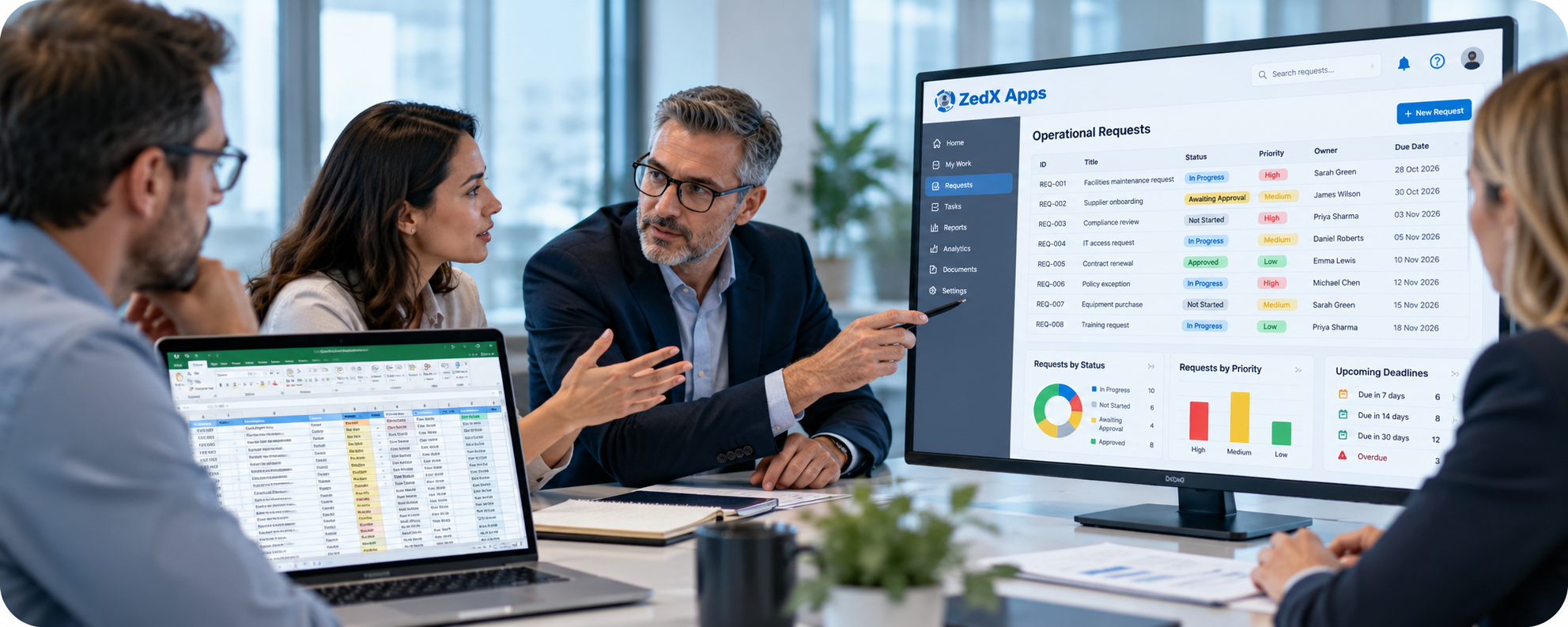
Consider a department managing hundreds of operational requests. Each request has an owner, priority, supporting documents, approval stages, deadlines and reporting requirements.
A spreadsheet can record this information, but it does not naturally provide the complete operational environment required to manage it effectively.
As these processes become more complex, organisations need to consider several important questions.
These requirements call for more than an electronic list.
They call for a structured application with a database, defined workflows, controlled access, automated processes and management reporting.
The objective is not to eliminate spreadsheets. It is to use purpose-built applications where the complexity, importance or volume of an activity justifies a more structured approach.
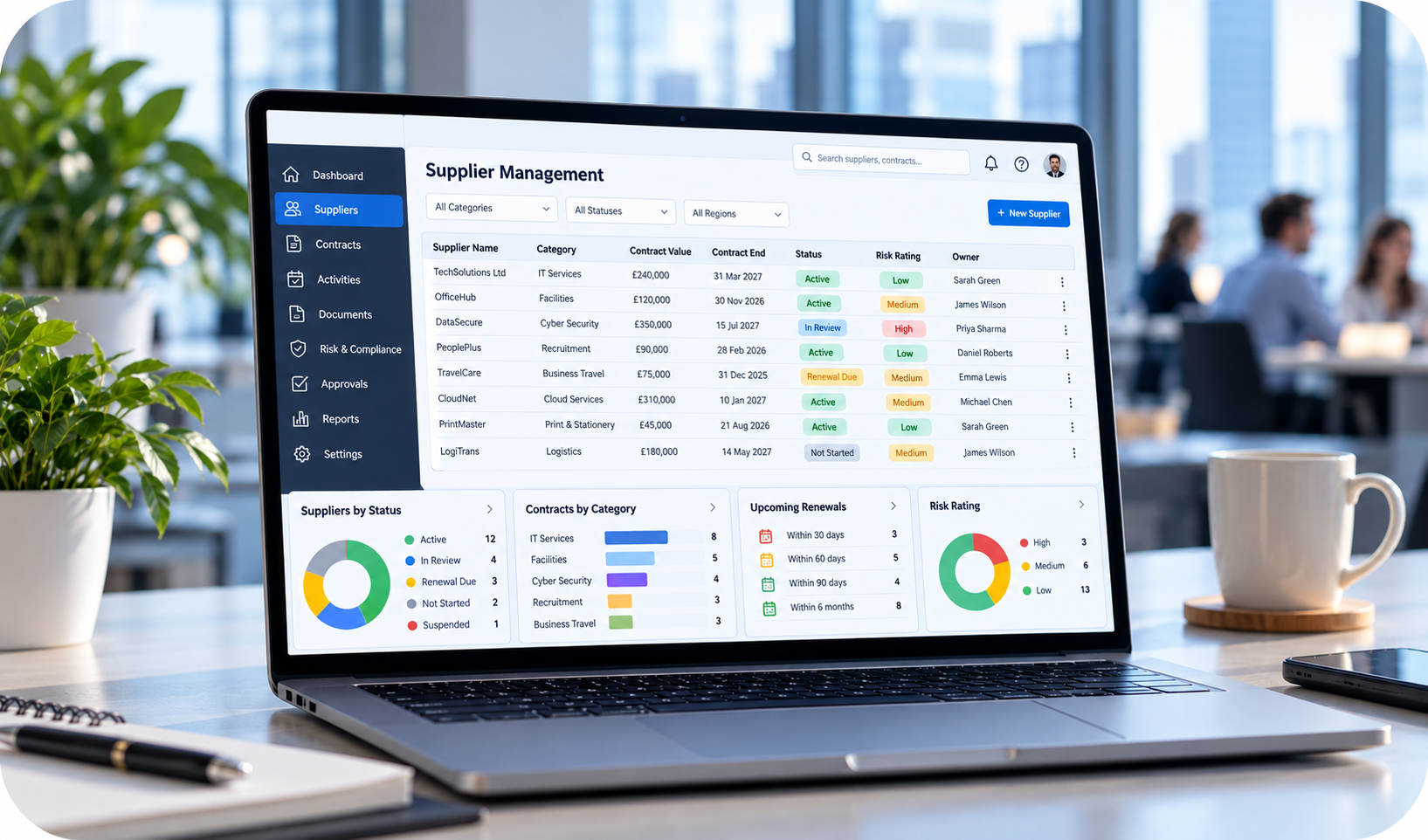
A tailored application can turn a collection of spreadsheets, emails and manual procedures into a coordinated business process.
Information is stored in a structured database, allowing users to manage records, assign responsibilities, attach documents, track approvals and monitor progress from one application.
Managers can view dashboards and reports without repeatedly requesting updates or consolidating information from different sources.
Importantly, the application can reflect the organisation's established terminology, responsibilities, management structures and operating procedures.
An HR consultancy, for example, may need to manage clients, consultancy matters, activities, documents and billable time. A compliance team may require similar functionality but with different assessment stages, evidence requirements and reporting arrangements.
Rather than forcing both organisations into an identical product, a tailored application can accommodate their differences while reusing common functionality.
The application should support how your organisation works, rather than forcing your organisation to work around the application.
Developing business software traditionally involves far more than creating the screens that users see. A development team must establish the underlying architecture, database structures, user authentication, access permissions, navigation, document management, reporting, security controls and deployment arrangements.
These capabilities are essential, but they are not necessarily what makes one organisation's requirements different from another's. Building them repeatedly adds cost, complexity and time.
ZedX Apps takes a different approach. Our platform already provides an extensive foundation of established functionality, supported by thousands of reusable software components. These components can be assembled, configured, extended and combined to develop new applications without rebuilding the underlying technology each time.
This allows development effort to concentrate on an organisation's particular requirements rather than recreating functionality that already exists. The result is a more efficient starting point for building tailored business applications.
The concept is easier to understand through an analogy.
Imagine constructing a building. One approach would involve manufacturing every window, door, light fitting, pipe and electrical connection individually before construction could begin. Another approach would use established, tested components, allowing architects and builders to concentrate on the design and purpose of the building. Modern software development can operate in much the same way.
A business application may require hundreds of individual capabilities, including forms, data tables, search functions, user permissions, document uploads, workflow stages, notifications, dashboards and reports. With ZedX Apps, many of these capabilities already exist. For example, consider an organisation requiring an application to manage internal approval requests. Rather than developing every feature from the beginning, we can reuse established functionality.
User Management - Identifying users, assigning roles and controlling access permissions.
Information Management - Creating, editing, searching and organising business records.
Workflow Management - Assigning work, recording progress and managing status changes.
Documents and Evidence - Associating supporting documents and files with individual records.
Management Reporting - Presenting operational information through tables, charts and dashboards.
Platform Services - Providing common navigation, security, administration and application infrastructure.
Our developers then concentrate on the particular approval processes, business rules, information requirements and user experience needed by the customer. This does not mean every custom application can be assembled without programming. New functionality and integrations may still require development. It means that developers can begin with a substantial technology foundation rather than an empty project.
The emergence of AI-powered development tools has made it easier than ever to generate software code. These technologies can accelerate development, but generating code is only one part of building a reliable business application. Organisations also need secure access, controlled data management, dependable architecture, testing, deployment, maintenance and ongoing support.
ZedX Apps is built on established technologies widely used in professional software development.
React - The User Experience
React provides the foundation for the application's web-based user interface. It supports responsive screens, interactive forms, dashboards, data tables and other capabilities that help users work efficiently. Applications can provide a consistent experience across the ZedX Apps portfolio while accommodating their own business requirements.
C# and .NET - The Business Logic
The application backend uses C# and Microsoft's .NET technology. This is where business rules, processing, validations, security checks and interactions with other systems are managed. Separating business logic from the user interface helps create applications that are easier to maintain, extend and integrate.
Microsoft SQL Server - Structured Business Data
Business records are stored in a structured Microsoft SQL database. Unlike a collection of independent spreadsheets, a relational database can manage connected information, preserve relationships between records and support controlled access, searching and reporting. This provides a more suitable foundation for many operational processes requiring reliable information management.
Microsoft Azure - Enterprise Cloud Infrastructure
ZedX Apps operates on Microsoft Azure.
For customers adopting this custom application model, the platform and application are deployed within their own Azure environment. This allows the solution to operate within an agreed infrastructure architecture and align with the organisation's security and governance requirements.
The result is professionally engineered business software built on an established, maintainable technology foundation, rather than an isolated application with no long-term development strategy.
An important additional benefit is access to the OpenAI capabilities integrated into ZedX Apps.
Rather than commissioning a separate AI application or building an AI integration from scratch, customers can benefit from AI functionality within the same environment used to manage their operational processes. Depending on the application's requirements and the information users are authorised to access, AI-assisted capabilities can include the following.
Information Assistance - Helping users understand information and procedures relevant to their activities.
Content Generation - Drafting summaries, descriptions, responses and other business text.
Record Summarisation - Producing concise summaries of lengthy records, discussions or supporting information.
Reporting Assistance - Helping users interpret operational information and prepare management commentary.
Knowledge Access - Finding and explaining relevant information from approved application records and knowledge sources.
Workflow Assistance - Supporting users with questions and routine administrative activities.
For example, a compliance manager could ask AI to summarise outstanding assessments, highlight issues requiring attention or help prepare a management report. An HR consultant might use AI to summarise an ongoing matter, prepare correspondence or review relevant supporting information. AI functionality operates within agreed security, access and data protection arrangements, with appropriate human oversight.
The objective is not to replace the professional judgement of employees. It is to reduce routine administrative effort and help people make better use of the information available to them.
A tailored application built on ZedX Apps can benefit from integrated AI capabilities without requiring the organisation to develop and maintain a separate AI solution.
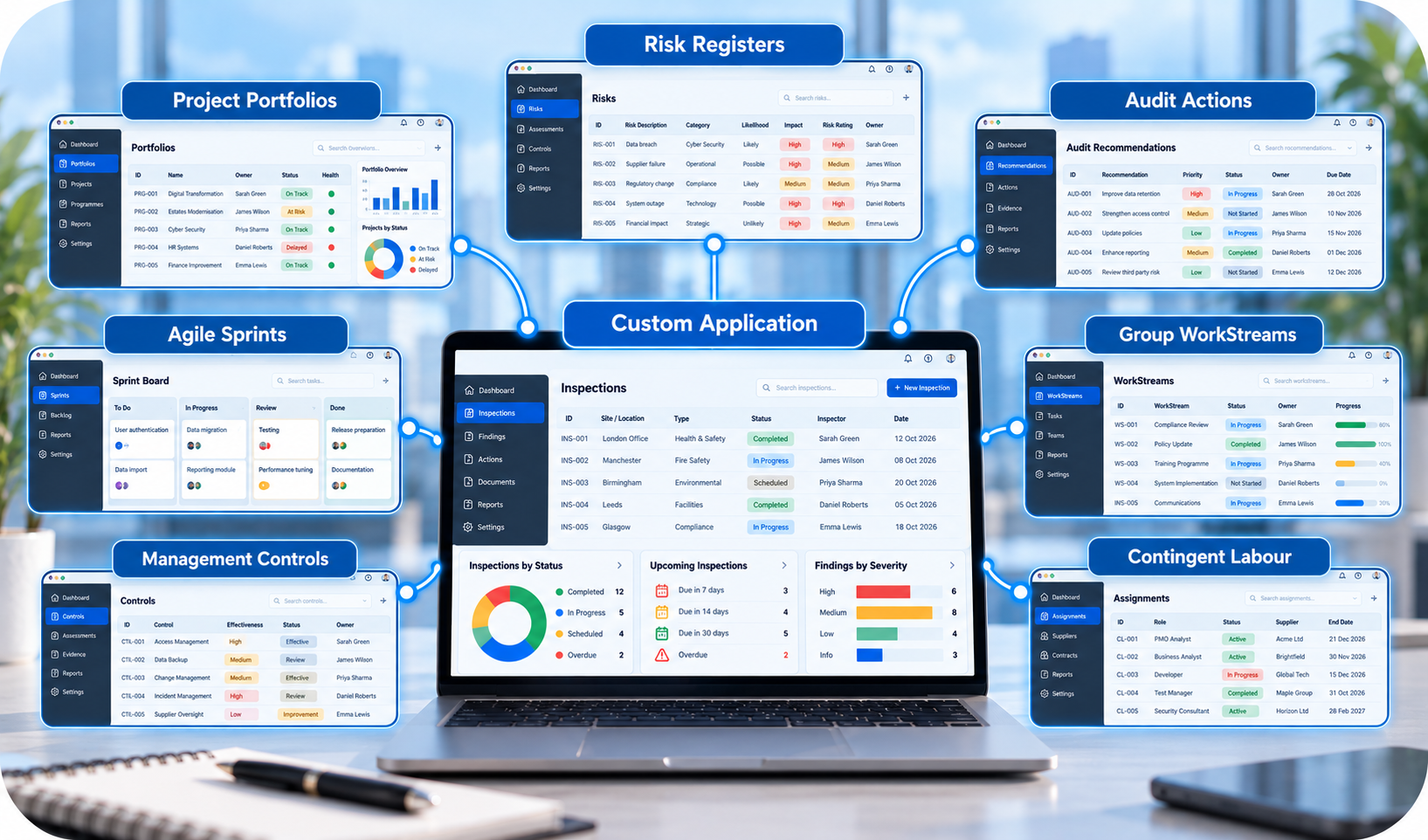
An important advantage of developing a new application on ZedX Apps is that it need not operate in isolation. ZedX Apps already includes applications supporting project delivery, Agile working, team coordination, risk management, audit recommendations, governance, management controls and contingent labour. A custom application developed on the same platform can take advantage of shared functionality and, where relevant and beneficial, integrate with these existing applications.
Consider an organisation commissioning an application to manage operational compliance inspections. The custom application might manage inspection schedules, findings, evidence and corrective actions. Where appropriate, the organisation could also use Risk Registers to manage significant risks, Audit Actions to follow up recommendations, and Group WorkStreams to coordinate associated activities.
These capabilities need not be duplicated within the new application. Instead, the organisation can benefit from a growing collection of complementary applications supported by a common technology platform. Integration requirements would be considered during business analysis and incorporated into the agreed solution design.
As your organisation's needs evolve, additional ZedX Apps applications can provide new capabilities without introducing an entirely separate software platform.
This approach is intended for established organisations that want to improve the efficiency, effectiveness and control of their internal business processes.
Suitable customers may include private companies, professional service firms, government departments, educational institutions, charities and other organisations managing substantial operational activities.
The opportunity is particularly relevant where existing processes involve spreadsheets, manual procedures, duplicated information or disconnected applications. The objective may be to reduce administration, improve accountability, strengthen governance, increase management visibility or provide employees with better tools for completing their work.
What This Offer Does Not Cover
This is not a general offer to develop commercial software products on behalf of startup businesses. It is not intended for entrepreneurs seeking to create an application that they will independently market, license or resell to third parties.
Our commercial model depends on Swiftpro retaining the software intellectual property and being able to develop configurable versions of the application for other organisations.
Customers retain ownership of their business data, while appropriate protections for confidential information and customer-specific requirements are established contractually.
Each proposed application must also be suitable for the ZedX Apps platform and demonstrate a reasonable opportunity for continued use across a wider customer base.
We are looking for organisations with genuine operational challenges, not businesses seeking to outsource the development of their own commercial software products.
A successful application starts with understanding the business problem, not writing software. Swiftpro approaches custom application development as a structured business change and technology delivery engagement.
The process begins with an experienced Delivery Lead / Business Analyst working directly with the customer.
Stage 1 - Discovery and Business Analysis
We work with operational managers, business users and other stakeholders to understand the organisation's existing processes. This includes reviewing current spreadsheets, documents, procedures, responsibilities, reporting arrangements and technology constraints.
We identify where current processes create unnecessary administration, operational risks or limitations on management visibility. The objective is to establish what the organisation genuinely needs rather than simply reproduce existing spreadsheets in a different format.
Stage 2 - Requirements and Solution Design
We document the proposed business processes, application functionality, user roles, information structures, reports and integration requirements.
Requirements are reviewed with stakeholders to establish a common understanding of the intended solution. Where appropriate, we also identify existing ZedX Apps functionality that could satisfy part of the requirement.
Stage 3 - Interactive Prototype
Before committing to the complete application build, we prepare a prototype demonstrating the proposed screens, navigation, forms and principal workflows.
Business users can review how the application would operate and identify changes while they are relatively straightforward to accommodate. The prototype provides a practical basis for agreeing the application's scope and design.
Formal customer sign-off establishes the baseline for development.
Stage 4 - Application Development
Following approval, Swiftpro develops the application using the established ZedX Apps platform and reusable components. New functionality is developed where necessary to address the agreed requirements.
Throughout development, the Delivery Lead coordinates clarification, progress reporting and customer engagement.
Stage 5 - Testing and Acceptance
The application undergoes technical and functional testing. Business users then validate the completed solution against the agreed requirements through user acceptance testing.
Any identified issues are addressed before the application is approved for production.
Stage 6 - Deployment to Customer Azure
For this Enterprise delivery model, the ZedX Apps platform and commissioned application are deployed within the customer's Microsoft Azure environment.
This provides an enterprise hosting arrangement under the customer's Azure tenancy, subject to the agreed architecture, access and operational responsibilities.
Swiftpro supports the configuration, deployment and initial introduction of the solution.
Stage 7 - Ongoing Subscription and Support
Following acceptance and go-live, the customer uses the application under an agreed ZedX Apps subscription.
The subscription provides the commercial basis for the software, including ongoing maintenance, standard updates and support.
The customer benefits from a tailored application without having funded a separately charged conventional software development project.
The organisation that initiates development has an important advantage. Rather than purchasing software and adapting its processes to accommodate the product, it participates directly in defining the application's initial functionality.
Its operational requirements help shape the solution from the beginning.
The customer receives a tailored application without paying the conventional development costs, together with the benefits of ongoing maintenance, support and future improvements through the subscription model.
As other organisations adopt configurable versions of the application, Swiftpro has an additional incentive to invest in its functionality, usability and technical capabilities.
The originating customer may therefore benefit from improvements and capabilities that would otherwise require further investment in an internally developed application.
This is a collaborative commercial arrangement rather than a conventional bespoke software development contract.
Developing a custom business application from scratch typically requires several specialist disciplines. Depending on the scale and complexity of the project, an organisation may need a Delivery Lead or Business Analyst, Solution Architect, UX Designer, Software Developers, Testers and DevOps expertise.
Some organisations employ these specialists directly. Others engage an external development consultancy. Either way, the organisation carries the cost of assembling, managing and funding the delivery team.
The following comparison illustrates the difference between conventional development and the ZedX Apps approach.
Actual requirements depend on application scope, complexity, integrations, customer availability and approval processes. Traditional delivery teams may use part-time specialists, while Swiftpro supplies its own technical resources under the proposed model.
For many organisations, the cost of developing software is not simply the number of people required. There is also the time involved in assembling a team, establishing the technology architecture, developing common functionality, testing the application and preparing the production environment.
A conventional development project may require five or six specialist resources working over five to nine months. With ZedX Apps, much of the technical foundation already exists.
For a suitably scoped application, this can reduce the initial delivery period to approximately two or three months, depending on the complexity of the requirements.
The customer funds the professional Delivery Lead / Business Analyst who works with its staff to define the requirements, produce the agreed design and coordinate delivery.
Swiftpro provides the underlying platform and development resources without a separate development charge.
The customer therefore avoids the need to assemble and fund a complete software development team.
When organisations assess the cost of developing applications internally, the initial development budget often receives the greatest attention. Yet software rarely remains unchanged.
Over its operational lifetime, an application may require security updates, technical upgrades, defect correction, functional enhancements, infrastructure changes and specialist support. These responsibilities can continue for many years.
Organisations developing software internally must retain the skills and resources necessary to undertake this work, even after the original development team has moved to other projects.
With ZedX Apps, the ongoing subscription includes maintenance, updates and support, providing a more predictable approach to managing the application over its operational lifetime.
Application Maintenance - Maintaining the software and addressing identified defects.
Security Updates - Providing relevant security fixes and technical improvements.
Technical Support - Supporting users and application administrators under agreed service arrangements.
Platform Improvements - Continuing to enhance the underlying ZedX Apps platform.
Software Updates - Providing standard application releases and improvements.
Ongoing Development - Continuing to improve common application functionality as requirements and technologies evolve.
Customer-specific changes and substantial new functionality would be assessed separately.
A Shared Interest in Long-Term Success
Unlike a conventional development project, Swiftpro's commercial relationship with the customer does not end when the application goes live.
The ongoing subscription provides a continuing incentive to maintain and improve the software. As additional organisations adopt the application, investment in its common functionality can benefit the wider customer base.
The comparison is therefore not simply between two ways of developing software. It is between owning the continuing responsibility for a bespoke software product and subscribing to an application maintained by a specialist software provider.